
The ancient religions refer to the diverse religious traditions and practices that emerged in various parts of the world in ancient times. These religions are characterized by their rich mythologies, elaborate rituals, and complex belief systems. Here are a few examples of some of the major ancient religions:
Ancient Egyptian religion: The religion of ancient Egypt was a polytheistic system that worshiped a wide range of gods and goddesses, including Osiris, Isis, and Ra. Ancient Egyptian religion was characterized by elaborate funerary rituals, including the construction of elaborate tombs and the mummification of the dead.
Ancient Greek religion: The religion of ancient Greece was a polytheistic system that worshiped a pantheon of gods and goddesses, including Zeus, Athena, and Apollo. Ancient Greek religion was characterized by elaborate festivals and rituals, including the Olympic Games and the Eleusinian Mysteries.
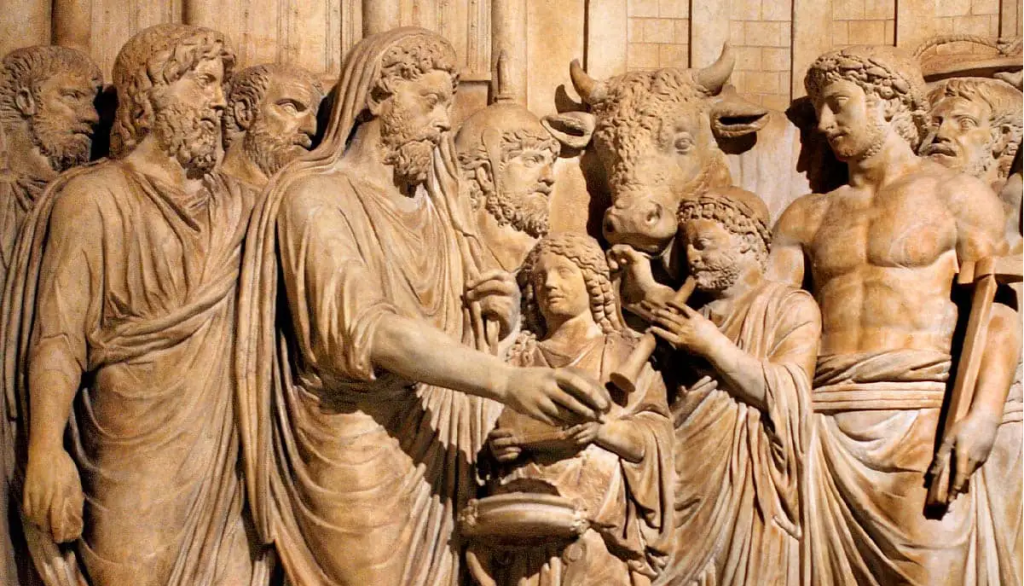
Ancient Roman religion: The religion of ancient Rome was a polytheistic system that was heavily influenced by the religion of ancient Greece. The Romans worshiped a pantheon of gods and goddesses, including Jupiter, Juno, and Mars. Ancient Roman religion was characterized by elaborate public festivals and rituals.
Ancient Mesopotamian religion: The religion of ancient Mesopotamia was a polytheistic system that worshiped a wide range of gods and goddesses, including Anu, Enlil, and Ishtar. Ancient Mesopotamian religion was characterized by elaborate temple complexes and ritual practices, including divination and sacrifice.
Ancient Chinese religion: The religion of ancient China was a complex and diverse system that included ancestor worship, the worship of nature spirits, and the veneration of a wide range of gods and goddesses. Ancient Chinese religion was characterized by the development of elaborate philosophical and ethical systems, including Confucianism and Taoism.
These are just a few examples of the diverse ancient religions that emerged in various parts of the world. While many of these religions are no longer practiced in their original form, they continue to influence contemporary culture and thought in a variety of ways.
Ancient Chinese religion was a complex and diverse system that included ancestor worship, the worship of nature spirits, and the veneration of a wide range of gods and goddesses. Here are a few key beliefs that were central to ancient Chinese religion:
1. Ancestor worship: Ancestor worship was a central feature of ancient Chinese religion. Ancestors were believed to have the power to influence the lives of their descendants, and were venerated through offerings of food, incense, and other offerings.
2. The Mandate of Heaven: The Mandate of Heaven was a central concept in ancient Chinese religion and political philosophy. It held that the emperor was granted the right to rule by the gods, and that his legitimacy depended on his ability to govern justly and effectively.
3. The Five Elements: The Five Elements (wood, fire, earth, metal, and water) were a central concept in ancient Chinese religion and philosophy. They were believed to govern the natural world and the human body, and were associated with a wide range of beliefs and practices, including astrology, medicine, and divination.
4. Yin and Yang: Yin and Yang were opposing forces that were believed to govern the universe and all things within it. Yin was associated with darkness, passivity, and the feminine, while Yang was associated with light, activity, and the masculine. The balance and interaction between Yin and Yang were believed to be essential to the harmony and balance of the universe.
5. The Four Pillars of Destiny: The Four Pillars of Destiny were a system of astrology that was central to ancient Chinese religion and philosophy. They were based on the year, month, day, and hour of a person’s birth, and were used to predict their future and guide their life choices.
These are just a few examples of the key beliefs of ancient Chinese religion. Ancient Chinese religion was a complex and multifaceted system that encompassed a wide range of beliefs and practices, and continues to influence contemporary Chinese culture and thought.